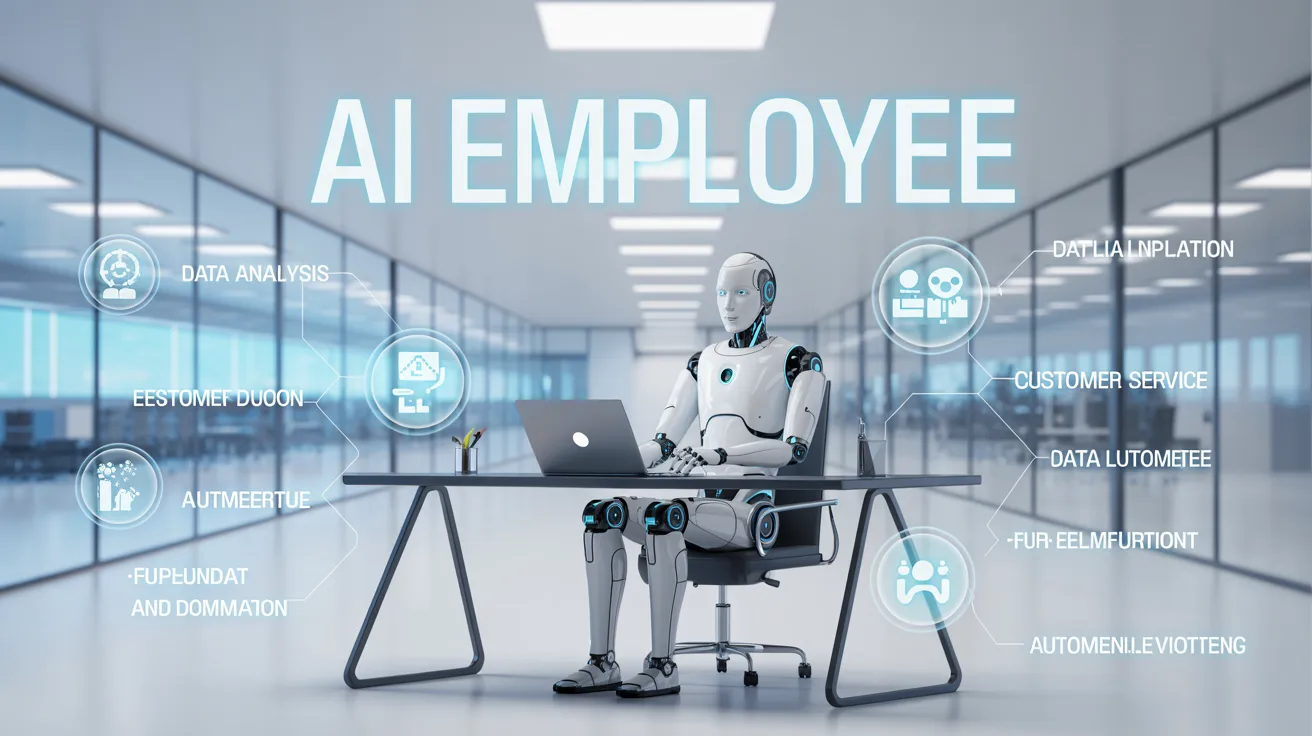
Not a Robot, But a Workflow Revolution
When most people hear "AI employee," they picture a humanoid robot sitting at a desk or a generic ChatGPT window pasted onto a website. The reality is far more powerful — and far more practical.
An AI employee is custom-built software that integrates directly into your existing business tools — your CRM, your email platform, your scheduling software, your invoicing system — and performs specific operational tasks autonomously, 24 hours a day, 7 days a week. It doesn't need a desk, a lunch break, or a benefits package. It doesn't call in sick on Monday or put in its two weeks when a competitor offers a dollar more per hour.
Think of it as a digital team member that lives inside your tech stack. It reads incoming leads from your website and routes them to the right salesperson. It answers customer questions at 2 AM using your actual service details and pricing — not generic FAQ responses. It reconciles data between your CRM and your accounting software so your team never has to copy-paste between tabs again.
This is not science fiction. This is what businesses across Phoenix and the East Valley are deploying right now to eliminate administrative bottlenecks and reclaim hours that were previously lost to repetitive manual work.
3 Tasks You Should Delegate to AI Today
If you're still on the fence about whether an AI employee is right for your business, consider these three high-impact use cases that deliver ROI almost immediately:
1. Instant Lead Qualification & Routing
Every minute a lead sits in your inbox without a response, your chances of closing that deal drop dramatically. Studies show that responding within five minutes makes you 21 times more likely to qualify a lead than waiting 30 minutes.
An AI employee can instantly evaluate incoming leads based on criteria you define — budget, service area, project type — and route qualified prospects directly to the right team member. Unqualified leads get a polite automated response. No lead falls through the cracks, and your sales team only spends time on prospects that are actually worth pursuing.
2. 24/7 Appointment Scheduling
Your customers don't operate on a 9-to-5 schedule, and neither should your booking system. An AI employee can handle appointment scheduling around the clock — checking your team's real-time availability, booking confirmed slots, sending reminders, and even rescheduling when conflicts arise.
For service businesses in Phoenix — HVAC companies, legal practices, medical clinics, real estate teams — this alone can eliminate the need for a dedicated scheduling coordinator. That's one fewer salary on payroll, with better coverage than a human could ever provide.
3. Automated Data Entry Between Apps
If your team is manually copying customer information from a web form into your CRM, then into your invoicing tool, then into your project management platform — you're burning hours every single week on work that a machine can do in milliseconds.
An AI employee connects your tools through secure API integrations and moves data between them automatically. A new lead fills out your contact form? Their information is instantly created as a contact in your CRM, a card on your pipeline board, and a draft invoice in your billing system. Zero human intervention. Zero data entry errors.
The Cost Difference: AI vs. Traditional Hiring
Let's talk numbers. Hiring a single full-time administrative employee in the Phoenix area costs roughly $35,000 to $50,000 per year in salary alone. Add in benefits, payroll taxes, training time, paid time off, and management overhead, and that number climbs closer to $55,000 to $70,000 annually.
That employee works 40 hours a week — minus holidays, sick days, and the inevitable afternoon productivity dip. They can only do one task at a time. They need to be trained on every new tool you adopt. And if they leave, you start the entire hiring cycle over again.
A custom AI employee, by contrast, operates on a flat monthly rate — typically a fraction of a single salary. It works every hour of every day without breaks. It handles multiple tasks simultaneously. It never needs retraining when you update your processes — it adapts instantly. And it scales with your business: whether you have 10 customers or 10,000, the AI handles the volume without you needing to hire additional staff.
The math is simple. For most Phoenix businesses spending more than 15 hours a week on repetitive administrative tasks, an AI employee pays for itself within the first month — and continues to generate savings every month after that.
The question isn't whether you can afford an AI employee. It's whether you can afford not to have one.