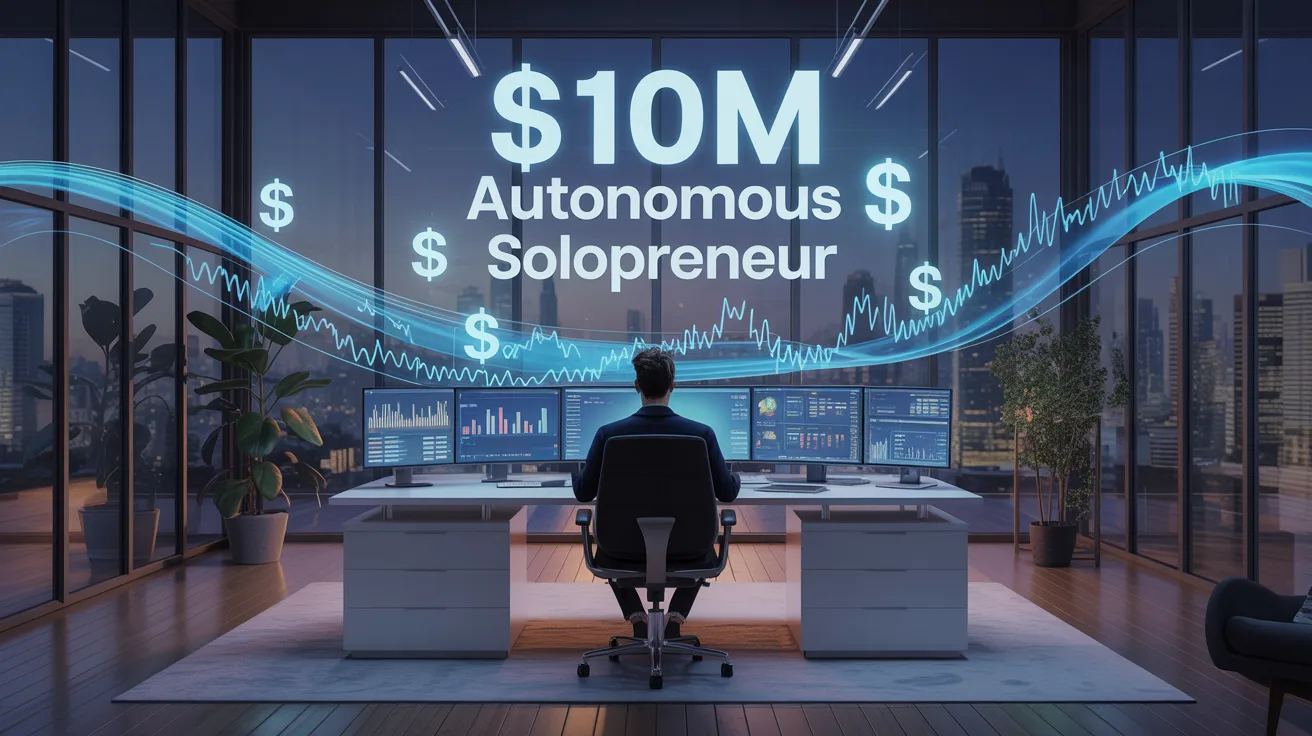
The "Digital Nomad" era of the 2010s was defined by young professionals working from laptops in Bali. The "Remote Work" era of 2020 was defined by Zoom calls and Slack notifications. But as of March 2026, we have entered a far more radical phase of global commerce: the era of the Autonomous Solopreneur.
We are witnessing the emergence of "Companies of One" that generate eight-figure revenues. This isn't happening through traditional scaling or hiring massive offshore teams. Instead, it is being driven by Agentic Orchestration—a shift from AI as a chatbot to AI as a fully autonomous workforce.
The Shift from Generative to Agentic AI
To understand how business automation has fundamentally changed in the last twelve months, we must look at the transition from Generative AI (GenAI) to Agentic AI.
In 2023 and 2024, we used AI to help us write emails, create images, or summarize documents. These were "human-in-the-loop" tasks. The AI was a tool, like a hammer or a calculator. By 2025, however, the breakthrough of long-horizon reasoning allowed AI models to execute multi-step plans without constant human prompting.
Today, in early 2026, we don't just "prompt" AI. We "delegate" to it. An Agentic AI unit doesn't just write a marketing plan; it researches the market, identifies the target audience, creates the ad creative, manages the bidding strategy on Google Ads, analyzes the conversion data, and adjusts the copy in real-time to optimize ROI—all while the founder is asleep.
The Architecture of the 10-Million-Dollar Solopreneur
How does a single individual manage a global enterprise? They build what we call an "Agentic Stack." This architecture is replacing the traditional organizational chart.
1. The Strategy Agent (The Chief of Staff)
This is the core LLM (Large Language Model) that sits at the top of the stack. It has access to the founder’s high-level goals, financial statements, and calendar. Its job is to provide executive oversight. It reviews the performance of all other sub-agents and alerts the human founder only when a critical decision—like a major pivot or a legal signature—is required.
2. The Growth & Acquisition Swarm
Instead of a marketing department, the autonomous solopreneur uses a "swarm" of agents.
- The Trend Scout: Scours social media, Google Trends, and academic papers to find emerging niche markets.
- The Content Factory: Generates high-fidelity video, audio, and written content tailored to specific platform algorithms.
- The Media Buyer: Operates autonomously across Meta, TikTok, and X, managing budgets and optimizing for LTV (Lifetime Value).
3. The Customer Success Layer
Customer support used to be the first "hire" for a growing business. Now, it is the last thing a founder worries about. Modern Agentic AI tools have "Actionable Memory." They remember every previous interaction with a customer, can process refunds via API integrations, and can even offer personalized upsells based on the user's specific pain points.
Case Study: The Rise of "Niche-Factory" Empires
Consider the case of a modern entrepreneur in 2026. Let's call him Alex.
Alex doesn't have a single "big idea." Instead, he has a "Niche-Factory." Using a suite of autonomous agents, Alex identifies micro-problems in various SaaS verticals.
- Step 1: His agents identify a lack of specialized CRM tools for indoor vertical farmers in Scandinavia.
- Step 2: An autonomous coding agent (evolution of GitHub Copilot/Devin) scaffolds a specialized SaaS product using modular components.
- Step 3: A deployment agent sets up the cloud architecture and security protocols.
- Step 4: A sales agent identifies decision-makers on LinkedIn and sends hyper-personalized outreach videos generated with AI avatars.
Alex spends his Tuesday mornings reviewing the dashboards. If a niche isn't performing, he clicks "Decommission," and the agents move on to the next opportunity. He has no employees, no office, and his overhead is 90% software tokens.
The Economic Implications: The Death of the Middle Manager
This shift is not without its casualties. The "Middle Management" layer of corporate society is being hollowed out. In the 20th century, companies grew by adding layers of management to handle information flow. In 2026, information flow is handled by AI agents that communicate via JSON and APIs at speeds no human can match.
For businesses, this means the "Minimum Viable Team" has shrunk from 10 people to 1.
For the labor market, this means a "Barbell Economy." On one end, you have high-level strategic thinkers who can orchestrate AI. On the other end, you have high-touch, physical world services that AI cannot yet replicate (construction, specialized healthcare, artisan crafts). The middle—the administrative, the repetitive, and the coordinative—is being automated.
Actionable Insights: Building Your Autonomous Infrastructure
If you are a business leader or an aspiring entrepreneur, how do you capitalize on this in 2026?
1. Stop Thinking in Tasks, Start Thinking in Loops
Standard automation is linear (If A, then B). Agentic automation is a loop (Goal -> Plan -> Action -> Review -> Adjust). Audit your current workflows. Which of them require you to make the same decision every week? Those are your first candidates for agentic orchestration.
2. Invest in "Clean Data" Pipelines
AI agents are only as good as the context they are given. To make your business "agent-ready," your data must be structured. Ensure your CRM, financial data, and customer feedback are in formats that agents can read and write to natively.
3. Master the "Orchestrator" Skillset
The most valuable skill in 2026 isn't coding or copywriting; it's Prompt Engineering for Logic. This involves defining the guardrails, the objectives, and the "Success Metrics" for your agents. You are the conductor of an invisible orchestra.
The Ethical Frontier: Trust and Transparency
As we delegate more of our business operations to autonomous agents, we face new challenges.
- The Transparency Gap: If an AI sales agent makes a promise to a customer, who is legally liable?
- The Hallucination Risk: While reasoning capabilities have improved, agents can still "hallucinate" logic.
- The Human Touch: As the world becomes flooded with AI-generated business interactions, "Human-Verified" content and brands will command a massive premium.
Conclusion: The Era of Individual Sovereignty
The promise of AI in 2026 isn't just "efficiency." It is Individual Sovereignty.
For the first time in history, the gap between a "dream" and a "global enterprise" has nothing to do with capital or head-count. It has everything to do with the quality of your ideas and your ability to orchestrate the silicon workforce at your fingertips.
The 10-million-dollar solopreneur is no longer a myth or an edge case. They are the new standard for the digital economy. The question is no longer, "Can you afford to hire?" but "Have you dared to automate?"
As we move further into 2026, the competitive advantage belongs to those who view AI not as a threat to their job, but as the infinite leverage that will build their empire. Low-code has become No-code, and No-code has become "Just-Tell-The-AI."
The barrier to entry has evaporated. The only thing left to build is everything.