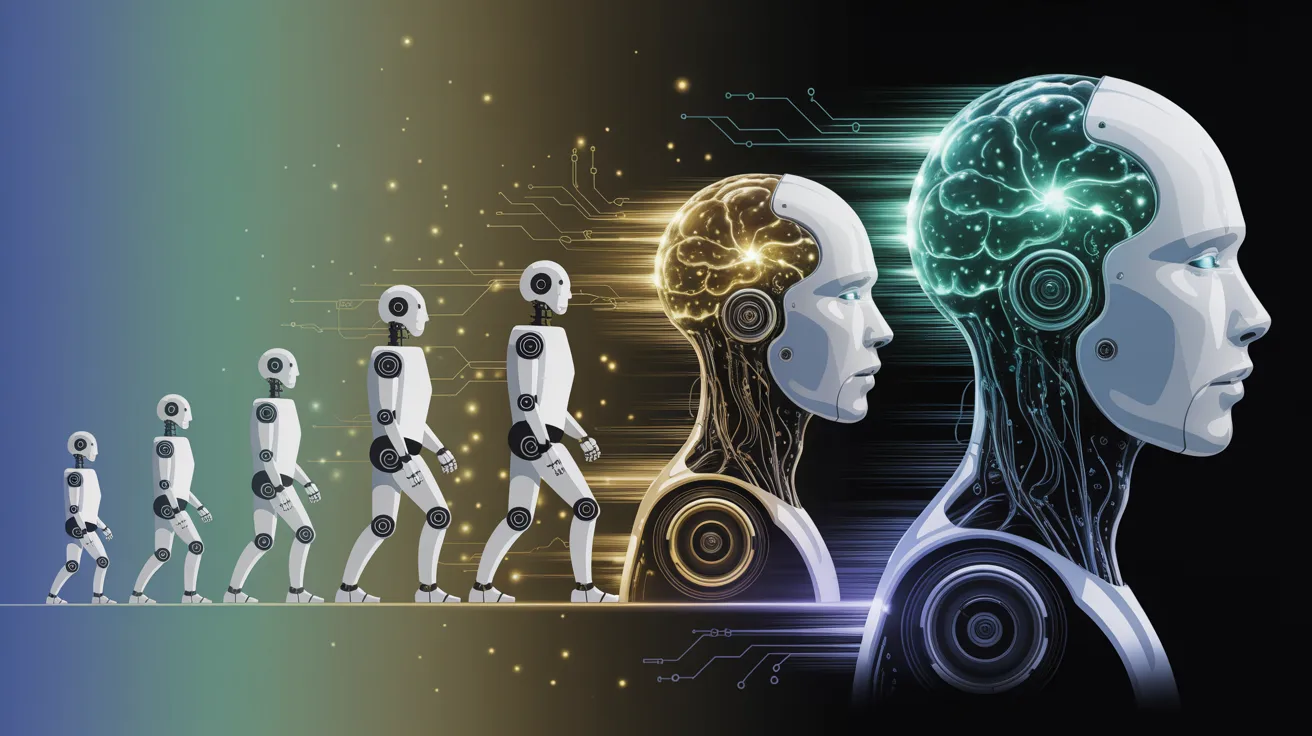
The "Early Adoption" phase of Artificial Intelligence is officially over. As of March 2026, we have moved past the era of novelty chatbots and basic image generation. We are now firmly entrenched in the age of Autonomous Business Architectures (ABA).
If 2023 was the year of the prompt and 2024 was the year of the agent, 2026 is the year of the Self-Healing Enterprise. In this new landscape, AI is no longer a tool you "use"—it is the specialized tissue that connects every department, predicting market shifts before they happen and reconfiguring internal workflows in real-time without human intervention.
The Shift from Copilots to Autonomies
For the past few years, the narrative focused on "Copilots"—AI assistants that sit beside a human worker to increase productivity. While Copilots haven't disappeared, they are being superseded by "Autonomies."
An Autonomy is a closed-loop AI system designed to own a specific business outcome rather than a specific task. For example, instead of a marketing manager using AI to write an email (Copilot), a Growth Autonomy monitors customer churn rates, identifies a segment at risk, designs a personalized retention offer, runs an A/B test on the creative elements, and deploys the winning campaign—all while the manager is asleep.
The shift is profound. We are moving from Human-in-the-loop to Human-on-the-loop, where the role of the executive is no longer to execute, but to govern the parameters and ethics ofautonomous systems.
1. The Rise of the "N of 1" Supply Chain
One of the most radical shifts in 2026 is the democratization of hyper-complex supply chain management. Previously, only giants like Amazon or Walmart could manage global logistics with high precision. Today, mid-sized SaaS and e-commerce companies are utilizing Predictive Synthesis Engines.
These engines don't just track shipments; they predict geopolitical instability, weather patterns, and even social media trends to preemptively reroute manufacturing. We are seeing the rise of the "N of 1" supply chain, where products are customized and routed for a single individual’s predicted needs.
Real-world example: A boutique fitness apparel brand now uses a "Temporal Demand" AI. This tool analyzed local marathon registrations and weather forecasts in Boston, automatically triggered a localized production run of lightweight thermal gear, and secured warehouse space three weeks before the demand spiked. Success in 2026 is measured by the ability to solve a problem before the customer even knows they have it.
2. Generative Finance: Beyond the Spreadsheet
Finance departments were historically the most resistant to AI due to the need for absolute precision. However, the emergence of Generative Finance (GenFi) has flipped the script.
GenFi tools don't just report on the past; they simulate thousands of "Parallel Futures." By 10:00 AM every Monday, a modern CFO receives a generated report of the three most likely economic paths for the next quarter, with automated hedge strategies already drafted for each.
The most valuable skill in finance today isn't accounting; it's Scenario Architecture. It’s about asking the AI, "What happens to our burn rate if the EU shifts its data sovereignty laws again?" and receiving a fully modeled impact analysis in seconds. This allows businesses to be "Antifragile"—a term coined by Nassim Taleb that has become the North Star for 2026 business operations.
3. The Death of the Traditional Org Chart
The most visible change in 2026 is how companies are actually structured. The rigid pyramid of 20th-century business is collapsing. In its place is the Fluid Swarm Model.
In a Swarm Model, projects are not assigned to departments. Instead, an AI "Orchestrator" analyzes the project requirements and dynamically assembles a team of internal human talent and external AI agents.
- The Talent Layer: Humans who provide creative direction, ethical oversight, and high-level strategy.
- The Agent Layer: Specialized AI models that handle coding, data extraction, legal compliance, and multi-lingual communication.
When the project is completed, the "Swarm" dissolves, and the individuals move to the next high-value priority. This eliminates "functional silos" and ensures that no human talent is wasted on administrative overhead.
4. Zero-Knowledge Customer Experience (ZKCX)
Privacy laws have tightened significantly over the last two years. The irony? Customer service has become more personalized than ever. This is thanks to Zero-Knowledge Customer Experience.
Using advanced edge computing and federated learning, businesses can now train AI models on personal user data without the data ever leaving the user's device. Your AI agent can talk to a company's AI agent to resolve a billing dispute or customize a product, exchanging "proofs" of data rather than the data itself.
For businesses, this means the end of the "data liability" era. You no longer need to hoard massive databases of sensitive information to provide a 5-star experience. You simply need to provide the most capable "Receptor AI" that can interface with the customer’s private data vault.
5. The Sovereign Employee and the Micro-SaaS Revolution
AI hasn't just changed how companies work; it has changed how people work within companies. We are seeing the rise of the "Sovereign Employee"—individuals who operate like mini-conglomerates.
Armed with personal AI stacks, a single developer or marketer can now do the work that previously required a team of ten. This has led to an explosion of Internal Micro-SaaS. Employees are building their own bespoke AI tools to automate their specific roles, then licensing those tools back to their employers or selling them on internal marketplaces.
This creates a fascinating incentive structure: the more an employee automates their own job, the more valuable they become as a "Tool Architect" rather than a "Task Executor."
Actionable Strategies for the 2026 CEO
If you are leading an organization in this "Self-Healing" era, your roadmap must include these three pillars:
A. Auditing for "Friction Debt"
Just as developers deal with technical debt, businesses accumulate "Friction Debt"—manual processes that survived the AI transition simply because "that's how we've always done it." Perform a monthly audit to identify any process that requires a human to copy-paste data between two systems. That is a prime candidate for an Autonomy.
B. Investing in "Context Windows," Not Just Models
The best model (LLM) is useless without context. The winners in 2026 are companies that have cleaned their proprietary data and built robust "Vector Memory" for their AI. If your AI doesn't know your brand voice, your 2024 tax strategy, and your 2025 customer feedback, it’s just a generic tool. Context is the new moat.
C. The Chief Ethics & Governance Officer (CEGO)
As rituals become automated, the risk of "Algorithmic Drift" increases—where an AI slowly moves away from human values or business goals in favor of raw optimization. The CEGO is now a mandatory C-suite role, responsible for ensuring that the "Self-Healing" systems aren't inadvertently causing harm or violating new global AI compliance standards.
The Human Element: The Renaissance of Intuition
As we automate the logical, the tactical, and the analytical, what remains? The uniquely human qualities of intuition, empathy, and taste.
In a world where every business has access to the same high-level intelligence, "Alpha" (the ability to beat the market) comes from the things AI can't do. It comes from the "gut feeling" a founder has about a cultural shift, the radical empathy a salesperson shows a grieving client, or the artistic "soul" embedded in a brand’s design.
The irony of the AI-driven 2026 is that it has made us more human. By offloading the "machine work" to the machines, we have finally cleared the schedule for the "human work."
Conclusion: The Future is Self-Configuring
The transition to Autonomous Business Architectures isn't just a technological upgrade—it's a philosophical one. It requires letting go of the illusion of control and embracing the power of orchestration.
The businesses that thrive in this decade are those that view AI not as a cost-cutting measure, but as a biological evolution of the enterprise itself. A company that can sense, react, and heal itself is not just a company—it’s a living entity.
As we look toward the 2030s, the question isn't whether AI will run your business. The question is: what will you lead once the business runs itself?